
Quantum Zeitgeist Weekly Digest


Welcome to this week’s quantum technology digest. We’ve compiled the ten most impactful stories from the past seven days, offering a snapshot of rapid development across the field. This week’s news reflects continued investment in core quantum capabilities alongside exploration of near-term applications.
Several articles point to a strong focus on error correction and qubit engineering. IBM expanded its resources through acquisition and integration of new tools, while research teams pursued advances in qLDPC codes and AI-assisted correction methods. Funding announcements from DARPA and the DOE demonstrate ongoing government support for validating designs and improving system performance.
Beyond hardware, developers are gaining tools for resource estimation and identifying practical uses for existing quantum computers. D-Wave’s public listing and collaborative work from Quantinuum and SoftBank signal increasing commercialization efforts. IonQ’s demonstration of energy efficiency for quantum AI adds to a growing body of evidence for specific computational advantages.
1. PsiQuantum Secures $125M DARPA Award to Validate Quantum Designs
PsiQuantum received a $125 million agreement from the Defense Advanced Research Projects Agency to support rigorous testing under the Quantum Benchmarking Initiative. The company is one of two participants in the program’s final Stage C, which verifies a complete quantum computing approach—hardware, software, and operations—beyond theoretical designs. This performance-based award will fund testing at PsiQuantum’s California and Illinois facilities, strengthening their photonic approach to scaling quantum systems and addressing challenges in cooling and connectivity. Micah Stoutimore of DARPA indicated a utility-scale quantum computer may be realized by 2033, and DARPA was assessing viable pathways to this goal at the time of the agreement.

2. Microsoft’s Tool Estimates Quantum Algorithm Resource Needs for Varied Hardware
Microsoft has released the Quantum Resource Estimator (QRE) within its Quantum Development Kit to help developers forecast the hardware requirements of quantum algorithms. The QRE translates programs into estimates of physical qubit counts, runtime, and error accumulation, and supports multiple quantum programming languages including Cirq, OpenQASM, and Qiskit. Its modular design allows for rapid comparison of algorithm performance across different qubit technologies and error-correction schemes, and recent QDK upgrades include Clifford simulation, QIR execution on CPU/GPU, and local neutral-atom simulation for more realistic modeling.

3. Routing Codes Cut Qubit Needs for Practical Quantum Error Correction
A team from the University of Science and Technology of China and Origin Quantum Computing developed routing codes, a new family of quantum low-density parity-check (qLDPC) codes. These codes achieve encoding rates similar to existing bivariate bicycle (BB) codes but require fewer connections between qubits and enable parallel operations, simplifying hardware construction for platforms like superconductors and neutral atoms. Circuit-level simulations showed weight-7 routing codes reduce physical qubit overhead by roughly a factor of eight compared to surface codes with equivalent error rates, representing progress toward scalable quantum computing. These results currently rely on modeling and do not yet reflect implementation on actual quantum hardware.

4. BlueQubit Receives $1.5M DOE Grant for AI-Enhanced Quantum Error Correction
BlueQubit, along with partners including Microsoft and Argonne National Laboratory, secured $1.5 million in U.S. Department of Energy grants to apply artificial intelligence to quantum error correction. The collaboration aims to reduce the physical qubit requirements and decoding time that currently limit quantum computer scalability and speed. This research focuses on creating AI-driven error-correction codes and faster decoding models to improve quantum processor reliability for applications in fields like pharmaceuticals and finance. The project intends to bridge the gap between theoretical codes and the practical limitations of existing quantum hardware.

5. IBM Acquires HRL Labs to Expand Quantum Qubit Engineering Capabilities
IBM completed the acquisition of HRL Laboratories, a research institution previously owned by Boeing and General Motors. The move strengthens IBM’s quantum computing program by adding HRL’s expertise in silicon-spin qubits, complementing IBM’s existing work with superconducting qubits. Boeing and General Motors will continue collaborative partnerships with IBM following the acquisition, focusing on quantum applications and technological development. IBM expects HRL’s advancements will support its quantum computing efforts in processing, sensing, and networking for years to come.
6. Quantinuum & UChicago Demonstrate Universal Quantum Gates with Anyons
Quantinuum and the University of Chicago announced they have demonstrated a complete set of operations for universal quantum computation using non-Abelian anyons. The team encoded qutrits – quantum bits with three levels of information – and manipulated them through braiding and fusion on Quantinuum’s H2 trapped-ion processor, entangling 54 qubits. This approach avoids resource-intensive magic state distillation needed for error correction in many current quantum architectures, potentially simplifying the path to reliable and scalable quantum processing. Their work, building on a 2024 demonstration with D4 symmetry, utilizes S3 symmetry to achieve the necessary computational power for any quantum algorithm. A study detailing this work was published in Nature on July 15, 2026.

7. D-Wave Begins Trading on Nasdaq Following Public Listing
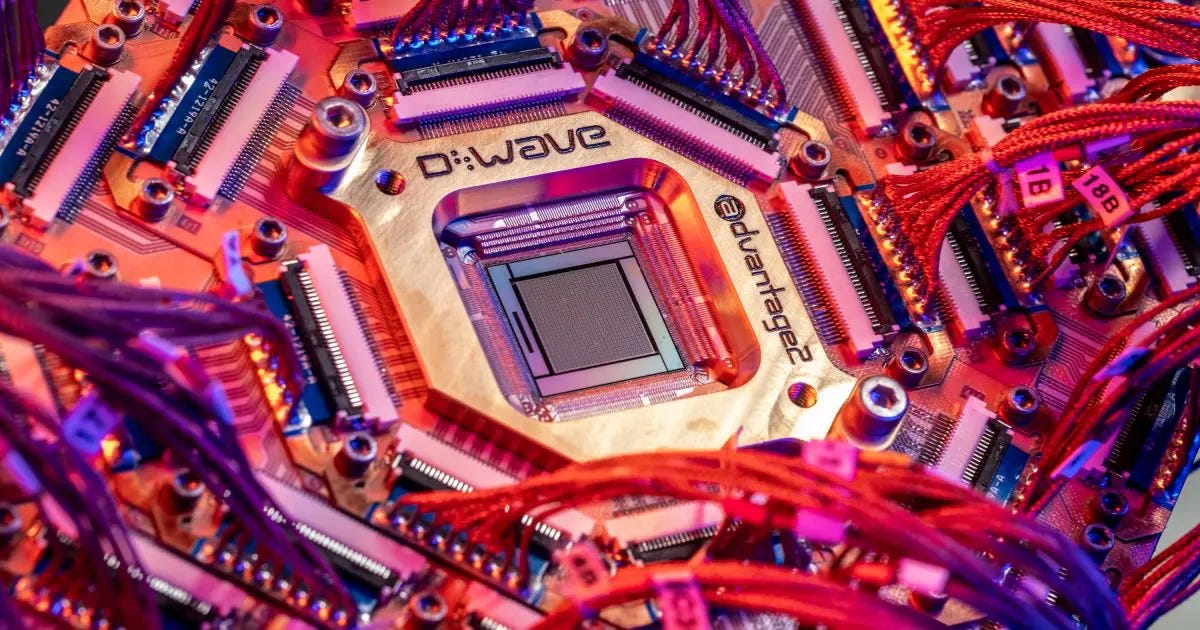
D-Wave Quantum Inc. marked its public listing on the Nasdaq exchange with a bell-ringing ceremony on July 27, 2026, following a voluntary transfer of its stock. The company is unique in offering both annealing and gate-model quantum computing systems, along with supporting software. D-Wave characterizes this listing as a milestone signifying its progress from research to delivering commercially viable quantum technology for enterprise and government clients. CEO Dr. Alan Baratz anticipates the listing will accelerate growth and commercial adoption.
8. IBM Integrates Quantum Elements’ Orbit for Improved Error Suppression
IBM Quantum has added Orbit, an error suppression tool developed by Quantum Elements, to its Qiskit Functions Catalog. Testing shows Orbit more than doubles the number of qubits effectively used in quantum Fourier transforms, a key quantum operation. The function aims to provide IBM Quantum Network members with a practical and cost-effective method to enhance circuit performance by applying dynamical decoupling techniques to suppress noise. This integration simplifies access to advanced error suppression for researchers and developers working with increasingly complex quantum workflows.
9. SoftBank & Quantinuum Detail Near-Term Quantum Computing Applications
Quantinuum and SoftBank Corp. released a joint white paper detailing commercially viable applications for current quantum hardware. The companies identified quantum chemistry for materials science and graph analytics for fraud detection as key areas for exploration. Their analysis demonstrates that organizations can begin realizing value from quantum computing without waiting for fully fault-tolerant systems, and focuses on integrating quantum systems with existing AI infrastructure. SoftBank is actively researching these applications with Quantinuum (NASDAQ: QNT) to inform future AI data center services.
10. IonQ Demonstrates Energy Advantage for Quantum AI Fine-Tuning
IonQ, collaborating with QuantumBasel and the Center for Quantum Computing and Quantum Coherence, demonstrated that quantum computations can use less energy than classical simulations for certain AI tasks. The research, presented at the IEEE Quantum Week conference, focused on measuring energy consumption (ETS) rather than traditional FLOPS, revealing an “energy break-even” point around 34 qubits on their IonQ Forte 36-qubit system. This work suggests trapped-ion quantum systems offer a path toward more sustainable AI, particularly for tasks like large language model fine-tuning, by offloading complex calculations from power-intensive classical hardware. Their hybrid quantum-classical pipeline also achieved a 24 percent reduction in error through filtering techniques.

The concept of the Quantum Node Economy proposes a future in which quantum computers are interconnected using secure quantum networks, similar to how the cloud currently allows disparate systems to communicate. Individual quantum nodes will not exist in silos, but rather will interoperate with artificial intelligence, high-performance computing, and the cloud in order to facilitate solutions for challenges across the health sciences, financial services, cybersecurity, logistics, energy, and the physical sciences.
Creating this type of ecosystem will necessitate three pillars. Infrastructure will be characterized by quantum processors, quantum networking and communication, cloud integration, and data security and transfer. Work force will require expertise in quantum computing, AI, cybersecurity, software development, photonics and systems engineering supported by institutions of higher education and industrial partnerships. Policy and governance will need to include standards and specifications for quantum technology, cyber security standards for quantum-safe communications, data protection, research and development incentives, international cooperation and ethical considerations for all of the aforementioned to spur development and protect national infrastructure.
The Quantum Node Economy is not meant to substitute classical computing, but to build upon it, uniting quantum computing, AI, and HPC as an intelligent, secure and an interconnected network to fuel future technological and economic advances.
A World at a Crossroads
In countries like the USA, the UK, Japan, and throughout the world, people are grappling with interconnected issues. From extreme weather events-intensified storms, heatwaves, and floods due to climate change-to escalating costs that strain household budgets and access to essentials like food, shelter, and healthcare, we face multifaceted challenges. Simultaneously, the breakneck pace of AI development presents awe-inspiring opportunities, alongside profound anxieties about the future of work, the erosion of privacy, and the amplification of misinformation.
Heightened political polarization and waning faith in established institutions hamper our capacity to address these issues collaboratively. In addition, mental health challenges, alienation, and pervasive stress continue to impact millions worldwide, particularly the youth. Our natural world is under immense pressure, with its vital ecosystems like forests and oceans, and diverse wildlife, facing unprecedented threats from a growing pool of environmental hazards such as pollution and climate change.
Despite these immense challenges, a beacon of hope shines through innovation: advancements in renewable energy, AI, medicine, and green technologies are developing solutions. Our collective future hinges upon the ability of governments, corporations, and individuals to collaborate effectively, safeguarding our planet, fostering resilient communities, and deploying technology wisely.
The decisions we take now will undoubtedly determine the legacy we leave behind for future generations. Whether individually or collectively, every action counts.