
Noisy Quantum Learning Theory Demonstrates Superpolynomial Gap Between NISQ and Fault-Tolerant Devices

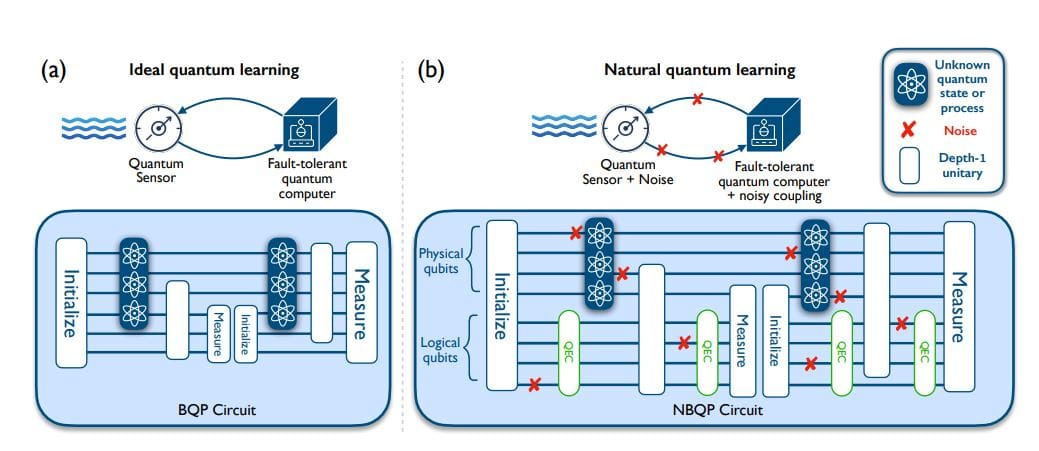
The challenge of extracting useful information from noisy quantum systems currently limits the potential of quantum technologies, and researchers are now investigating how this noise impacts the very foundations of quantum learning. Jordan Cotler from Harvard University, Weiyuan Gong from Harvard University, and Ishaan Kannan from Caltech, alongside their colleagues, develop a comprehensive framework to understand how noise affects the ability of quantum devices to learn from experiments. Their work demonstrates that common sources of noise can eliminate the significant learning advantages expected from ideal quantum systems, effectively blurring the line between current, limited “noisy intermediate-scale quantum” (NISQ) devices and the powerful, fault-tolerant quantum computers of the future. Importantly, the team identifies specific scenarios, inspired by theoretical physics, where noise-resistant structures can restore learning advantages, and they establish fundamental limits on how effectively we can characterise quantum systems in the presence of noise, paving the way for designing more robust quantum algorithms and experiments.
