
Microsoft Unveils Majorana 2
A 1,000-Fold Qubit Reliability Improvement For The Topological Chip

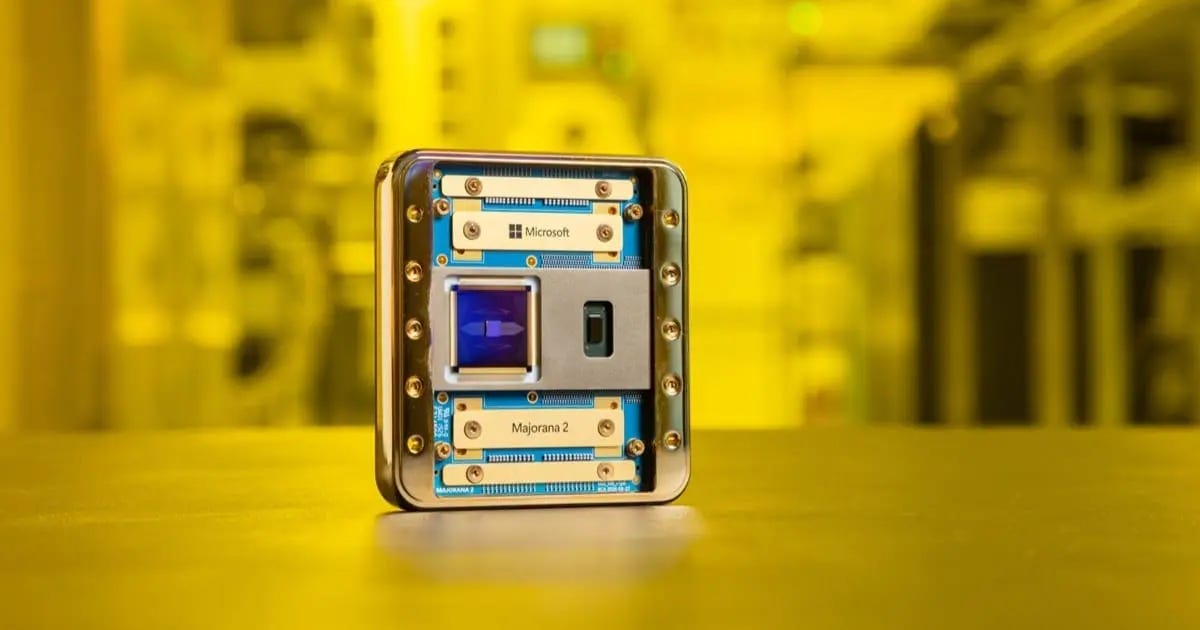
Microsoft has unveiled Majorana 2, a quantum chip that achieves a 1,000-fold improvement in qubit reliability by applying its agentic AI platform, Microsoft Discovery. The new chip features a mean qubit lifetime of 20 seconds, with individual qubits maintaining their quantum state for up to 1 minute, a significant step forward in stability for practical quantum computation. This advancement has accelerated Microsoft’s timeline for a scalable quantum computer, halving its original estimate. “We’ve got to keep marching to that roadmap to accomplish that, but where are we relative to last year? We’re 1,000 times better,” said Chetan Nayak, Microsoft technical fellow, highlighting the significance of this progress toward tackling complex challenges in fields like global health and sustainability.
Majorana 2 Achieves 1,000x Reliability via New Materials Stack
This extended coherence is comparable to developing a phone battery that lasts nearly three years on a single charge, fundamentally altering the possibilities for complex quantum calculations. The enhanced stability of Majorana 2 stems from a redesigned materials stack, a critical component in shielding fragile qubits from environmental disturbances. While the initial Majorana prototype utilised aluminium, the new iteration employs lead, a material widely used for radiation shielding in medical and industrial applications. According to Chetan Nayak, Microsoft technical fellow, “We need to make improvements each year that will get us closer to delivering a computer that we believe will have massive commercial and societal value.” The transition to lead wasn’t straightforward, requiring years of research to mitigate potential trade-offs, but the resulting improvements in device quality have been significant. This meticulous materials science, coupled with the application of agentic AI, has demonstrably improved performance.
Microsoft’s internal AI platform, Microsoft Discovery, played a pivotal role in accelerating this progress. The platform allows researchers to deploy AI agent teams, guided by human expertise, to expedite scientific discovery and overcome longstanding barriers in quantum computing. The team leveraged agentic AI to manage the manufacturing process of the new device and is expanding its use for future materials research. The complexity of building these devices at the atomic level requires precise control over material composition; adding impurities to crystalline structures to fine-tune energy levels is a delicate balancing act.
Zulfi Alam, corporate vice president for quantum at Microsoft, explains that “Finding the exact recipe, the right amount to put to get the desired energy structure, requires a lot of experimentation in the past. In the current approach, simulations show where the most probable target is. And then with that knowledge, you ideally only have to experiment once.” The impact of this improved reliability extends beyond simply lengthening qubit lifetimes. The combination of 20-second coherence, one-microsecond operation speeds, and a qubit size of just 1/100th of a millimetre has propelled Microsoft to revise its timeline for achieving a scalable quantum computer.
The company now projects this milestone by 2028, halving its original estimate. Nayak stated, “We’re 1,000 times better,” highlighting the magnitude of the recent advancements. The agentic AI isn’t merely assisting with materials science; it’s also streamlining data analysis, synthesising knowledge across disparate disciplines, and accelerating experimental cycles, ultimately positioning Microsoft to tackle complex problems in fields ranging from global health to sustainable energy.
Microsoft Discovery’s Agentic AI Accelerates Quantum Research
The pursuit of a stable and scalable quantum computer has long been hampered by the inherent fragility of qubits, the quantum equivalent of bits. Current systems struggle with maintaining qubit coherence, the duration a qubit reliably holds quantum information, limiting the complexity of calculations possible. While advancements in materials science and qubit design continue, a new catalyst is emerging to accelerate progress: agentic artificial intelligence. Microsoft is leveraging its recently released Microsoft Discovery platform, deploying AI “agent teams” to tackle the multifaceted challenges of quantum research, and the results are already demonstrably impacting the development of its Majorana 2 quantum chip. Beyond simply automating existing processes, Microsoft’s approach utilises AI to actively participate in the scientific process, extending from materials science to fabrication and measurement.
The team transitioned from aluminium to lead in the superconductor materials stack of Majorana 2, a change that required years of research to overcome associated tradeoffs. “That was actually a fairly large change, and it led to big improvements in device quality,” said Chetan Nayak, Microsoft technical fellow. While materials research predates the advent of agentic AI, the platform is now instrumental in managing the manufacturing process and is poised to play an even larger role in future materials work. The power of agentic AI lies in its ability to synthesise information across disparate disciplines and massive datasets. Microsoft’s quantum project generates nearly two decades’ worth of data in various formats, previously siloed and difficult for human researchers to fully analyse. “As you run AI agents on this data, they’re able to essentially resynthesize and make correlations that we as humans cannot see,” Alam stated.
This capability is particularly valuable given the geographically dispersed nature of the quantum team, encompassing experts in physics, engineering, and fabrication. The AI acts as a central knowledge hub, organising information and facilitating collaboration. Alam added, “The AI is able to synthesise knowledge from all these different disciplines,” saving everyone the time and hassle of interviewing the specialists. This collaborative acceleration has demonstrably impacted Microsoft’s timeline, now projecting a scalable quantum computer by 2028, effectively halving its original estimate. Nayak stated, “We’re 1,000 times better.” The integration of agentic AI isn’t simply about speed; it’s about unlocking new insights and accelerating the path toward a commercially viable quantum future.
Source: https://news.microsoft.com/source/features/innovation/majorana-2-microsoft-discovery-agentic-ai