
25× Throughput Gain From IBM Quantum’s New Reset Design
Big Blue And New Nighthawk r2

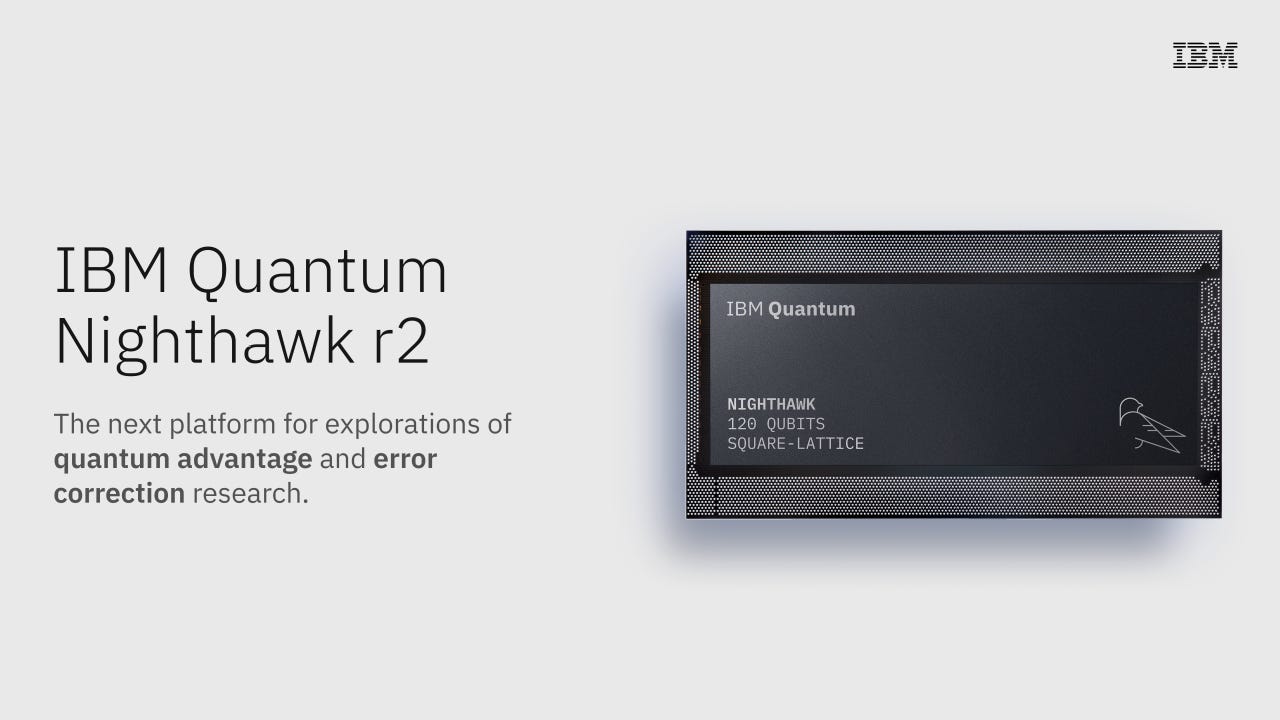
IBM Quantum has achieved a 25-fold increase in circuit throughput with its new Nighthawk r2 processor, enabled by a redesigned qubit reset mechanism that addresses a longstanding challenge in quantum computing. Achieving fast qubit resets demanded a dynamic range of approximately 100,000 for T1 times, a specification the team now meets through innovative tunable couplers. The Nighthawk r2 chip incorporates this design to quickly and independently reset each of its 120 programmable qubits, observing a median T1 time of 200 microseconds when the reset is off, decreasing to 25 nanoseconds when activated. Jay Gambetta says this ability to unconditionally reset a qubit into its ground state quickly is a key ingredient as error correction matures, highlighting the significance of this advancement for both circuit speed and improved initialization, with observed initialization error reduced by a factor of 11.
Tunable Couplers Enable High-Speed Qubit Reset to 25ns
The team’s approach centers on tunable couplers, designed to minimize qubit-qubit coupling when deactivated, while maintaining strong coupling when engaged, allowing for rapid state preparation without disrupting neighboring qubits. This innovation addresses a critical bottleneck in quantum computing; quickly returning a qubit to its ground state is essential for reliable error correction, demanding both a substantial reduction in T1 decay times and the ability to do so without impacting adjacent computational elements. IBM Quantum Nighthawk r2, the company’s processor, incorporates this new reset design and is capable of resetting each of its 120 programmable qubits independently. The device demonstrates a median T1 time of 200 microseconds when the reset function is disengaged, a performance level comparable to dedicated test structures, but activating the reset feature dramatically reduces this to just 25 nanoseconds, representing a 25-fold increase in speed.
Researchers report no observed degradation in T1 times on neighboring qubits during the reset process, demonstrating the effectiveness of the tunable couplers in isolating the operation. This advancement translates directly into improved processor throughput; idle time following circuit execution can now be reduced from approximately 250 microseconds to as little as 1 microsecond. The company anticipates this will allow clients to run circuits at a rate of up to 100,000 per second on Nighthawk r2, a 25-fold improvement over the 4,000 circuits per second achievable with the previous generation Heron processor. Beyond speed, the new reset capability also enhances initialization fidelity, yielding an 11-fold reduction in initialization error across the Nighthawk r2 device by effectively cooling qubits with a 50 Ohm termination. The architecture of Nighthawk r2 is complex, supporting the 120 programmable qubits with an additional 338 physical qubits dedicated to coupling and reset, bringing the total on-chip qubit count to 458.
Nighthawk r2 Achieves 100 kHz Throughput & Reduced Initialization Error
The pursuit of practical quantum computation hinges on minimizing errors, and a critical component of error mitigation is the ability to rapidly and reliably reset qubits to their ground state; current systems struggle with the necessary speed and precision to make this feasible at scale. IBM Quantum’s Nighthawk r2 processor addresses this challenge with a novel reset mechanism integrated directly into its design, representing a substantial performance leap. This speed isn’t achieved at the expense of qubit coherence elsewhere on the chip; the design incorporates high-dynamic-range tunable couplers that effectively isolate the reset process, preventing interference with neighboring qubits. The company reports that they have not observed a degradation of T1 on neighboring qubits when a qubit is reset, owing to the ability to turn tunable couplers between qubits off. This isolation is crucial for maintaining the integrity of complex quantum calculations.
Consequently, IBM Quantum is introducing a new metric to quantify processor performance: maximum circuits per second. While the Heron processor achieved up to 4,000 circuits per second (4 kHz), Nighthawk r2 boasts a throughput of 100,000 circuits per second (100 kHz), a 25-fold improvement. The Nighthawk r2 isn’t just a collection of 120 qubits; it’s a complex system comprising a total of 458 on-chip physical qubits, including the 338 dedicated to coupling and reset functions, demonstrating the hardware overhead required for advanced qubit control.
Source:
https://www.ibm.com